Dungeon Memory Coming to Kickstarter

The campaign
remembers itself.

Dungeon Memory is a memory engine for long games. Paste what happened at the table. Ask it anything, months later, and get an answer with the sessions it came from.

One email, when the campaign opens. Nothing else, ever. Stored in the EU; reply to that one email and it is deleted.

The thing nobody talks about

Session 14. Someone asks who the merchant's brother was, and whether he was at the fire. You have forty pages of notes, a Discord scrollback, and a clear memory of writing it down somewhere. The table waits four minutes, and then you make something up.

Every long campaign dies of this a little at a time. Not from bad ideas — from forgetting the good ones.

Three things, and only three

I

Paste the session

Typed notes, a photo of your handwriting, or a voice recording of the drive home. It reads all three, in English, Italian, Spanish, French and German — and it keeps invented names exactly as you wrote them.

Ambrose Vance the ledger the silver key Weavers’ Quarter Garrick Holloway

It links the new night to the people it already knows.

II

Confirm what it understood

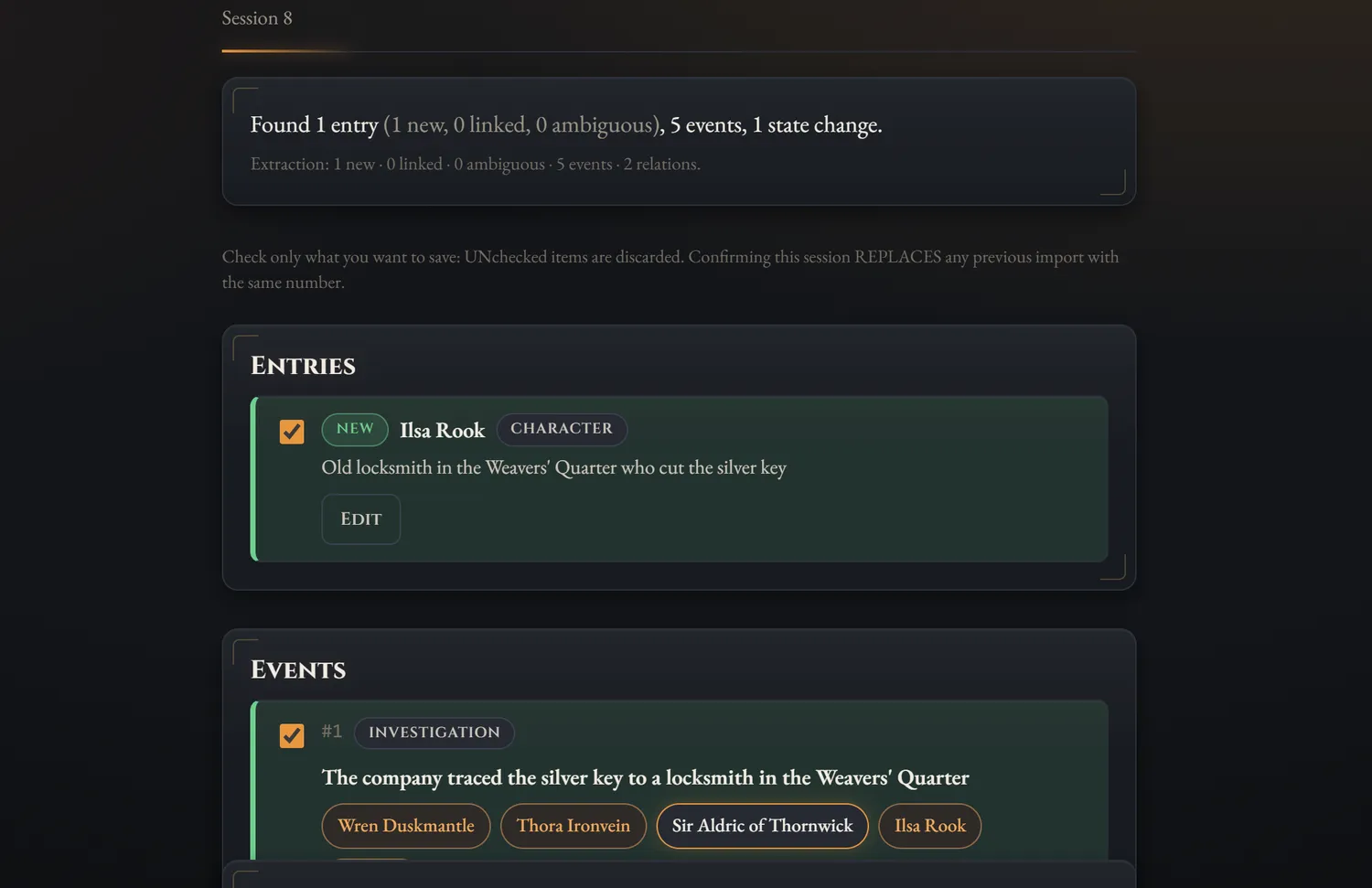
Nothing touches your world until you approve it. You get a diff — new people, links to people it already knows, events, changes of state — and you tick what is true. It also tells you when the session contradicts something you wrote before.

The confirmation screen: one new entry, five events, one state change, each with a checkbox, and a switch reading Share this session with the table.
The real screen. Tap to read it full size.

III

Ask instead of searching

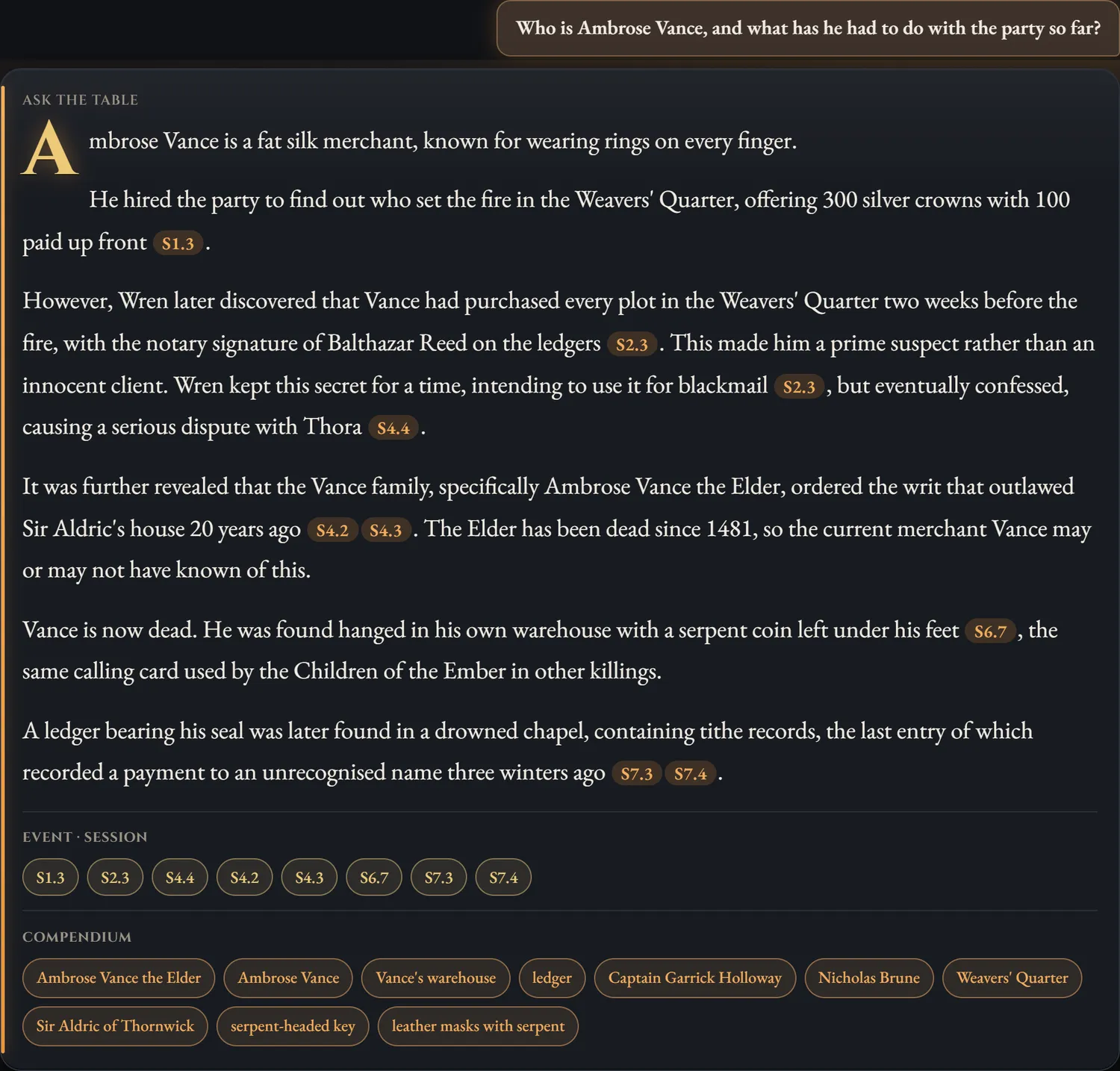
Plain questions, plain answers — and every claim carries the session it came from, so you can check it in one tap. If a fact is not in your sessions, it says so instead of inventing one.

S1.3 S4.2 S6.7 S7.4 not recorded

Every line carries where it came from — or admits it does not know.

A question about a character, answered across five sessions, each statement tagged with the session and event it came from.
A real answer, drawn from five different sessions of a real campaign. Tap to read it full size.

The number you do not have to watch

Keep playing. There is no session limit.

Nothing in this engine counts your sessions — there is no quota to run down and no wall to hit. The past folds into itself as it recedes: a question is answered from a context of fixed size, so it costs the same on a long campaign as on a young one, and the newest night takes the same seconds to read as the first one did.

What we can put a number on is the thing that actually breaks a memory: age. Not how much a tool holds — how old a fact can get before it quietly loses it. So we ran one campaign to two hundred sessions, four years of weekly play, and then asked it about its first night.

  • 199sessions between the fact and the question, at the oldest
  • 23/25questions answered correctly, spread across all two hundred
  • 4smedian time to an answer, sources attached
  • 0%slower at the two hundredth session than at the twentieth

Two hundred sessions, 991 events, and reading a night still took the same twelve seconds it took on the first one. It did lose something: one fact from session nine — a line someone found in their own handwriting — was still in the archive but did not surface. We would rather tell you that than round it away. The other question it “missed” asked what was unresolved at the end, and after four years the end had moved. Measured on our own campaign, not a public beta: we will say so plainly if wider use shows something different.
And the people you play with

What your players see

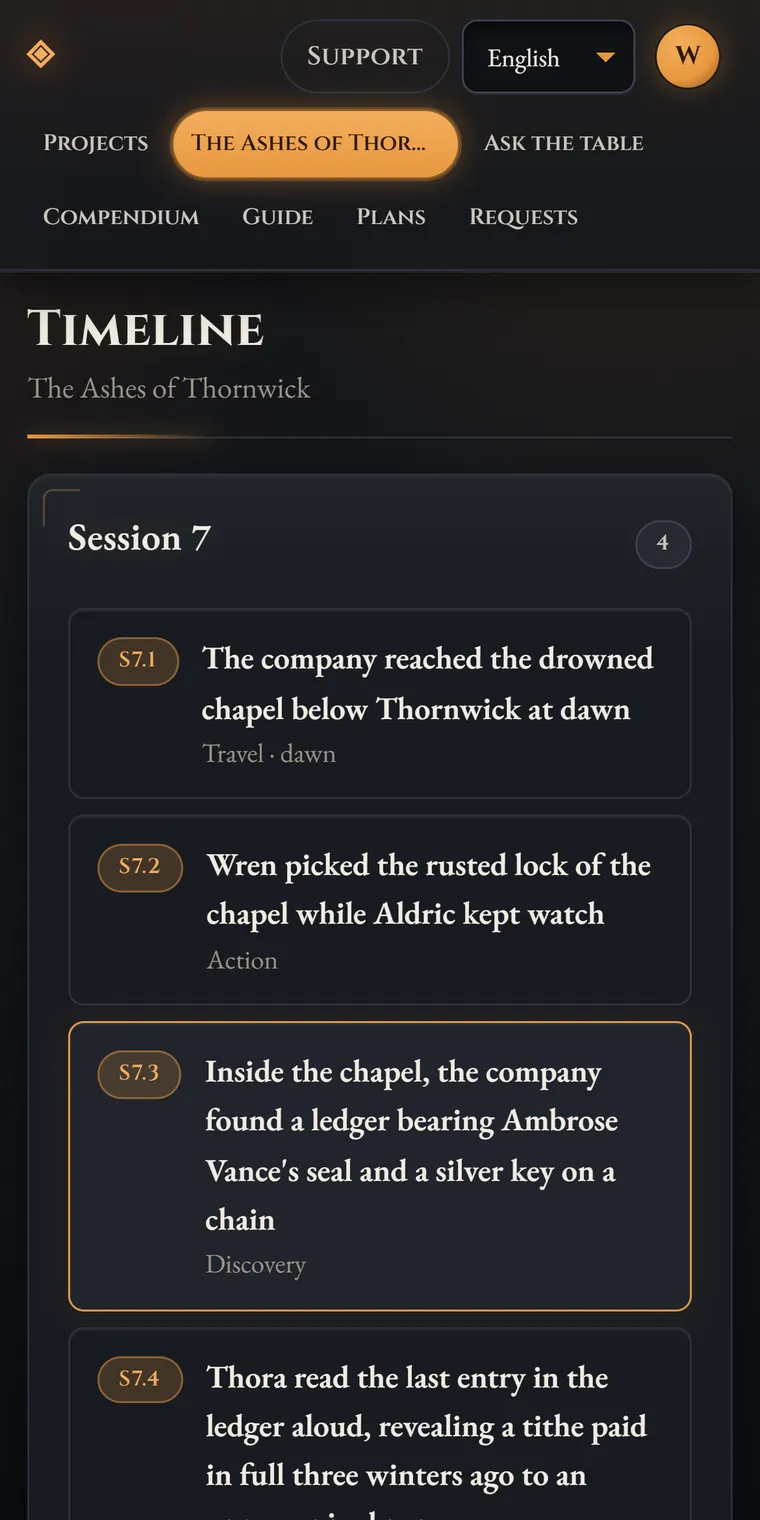
When you save a session there is one switch: share this session with the table. Your players get the recap and the timeline for the sessions you opened — on their phone, at the table, without asking you.

And nothing else. The entries you keep to yourself stay yours; so do your plot threads, your notes and the raw text you pasted. Open a session by mistake and one click closes it again.

A player's timeline on a phone, showing only the sessions the gamemaster has shared.

Three promises, kept by leaving things out

What it is not

  • It does not play for you. No generated encounters, no rolled dice, no NPC voices.
  • It does not write your story. The assistant suggests threads you left open; you decide, and nothing it says becomes canon on its own.
  • It does not invent. Names, dates and facts come from your sessions, or the answer says it does not know.

The Kickstarter

It is built and it works — what it needs now is enough people to make it worth running properly: the servers, the transcription, and the year of support that a tool like this has to promise before anyone can trust their campaign to it.

One email, when the campaign opens. Nothing else, ever.